A Pattern of Disregard: How Administration Policies Impact Children’s Futures
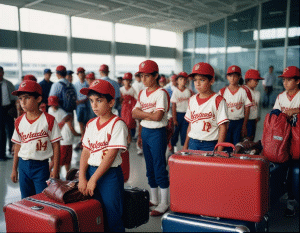
The dreams of a Venezuelan Little League team came to a halt this week, as the United States denied entry of the Cacique Mara squad from Maracaibo for the Senior League Baseball World Series. The decision stemming from the administration’s renewed travel ban on Venezuela has sparked outrage and drawn sharp criticism regarding its impact on young people.
The team, composed of players aged 13-16, had triumphed in the Latin American championship in Mexico, earning their rightful place at the global tournament in Easley, South Carolina. However, the U.S. rejected their visa applications, crushing their hopes. Little League International expressed deep disappointment, emphasizing the immense effort and dedication these young athletes invested.
Venezuelan Little League officials directly attributed the denial to the travel ban, which designates Venezuela as a country posing national security threats. “They told us Venezuela is on a list because [the President] says we are a threat. But these are children. They earned their place by winning,” stated Kendrick Gutiérrez, president of the Venezuelan Little League.
This rationale raises questions about the perceived vulnerability of the United States to a group of teenage baseball players, suggesting an alarming level of weakness that demands such extraordinary measures. If the nation’s security apparatus, including its hundreds of Immigration and Customs Enforcement (ICE) agents, cannot manage the entry of a youth sports team without resorting to a blanket ban, its fundamental strength must be in question.
Make no mistake, this is just a small part of the administration’s assault on children. Proposed Medicare cuts threaten essential healthcare for our youngest and most vulnerable, while severe SNAP restrictions risk increasing childhood hunger. The push for a national school voucher system funnels crucial funds away from public schools, undermining the quality of education for the vast majority of students. This, coupled with cuts to vital education grants, leaves schools struggling. The continuation of family separations at the border inflicts deep, lasting trauma on children, creating an environment of fear and instability that profoundly affects their mental health and development. These measures collectively reveal a troubling disregard for the fundamental needs of children.
As other questions mount over the plausibility of a Venezuelan Little League team posing a genuine security threat to the United States, voices are increasingly suggesting ulterior motives behind the visa denials. With no credible evidence justifying that a group of teenage athletes and their chaperones could orchestrate or execute a terrorist act, the administration’s rationale is facing heightened scrutiny, and accusations of racial bias are surfacing.
“Let’s be clear,” stated Eleanor Vance, a spokesperson for the civil rights advocacy group ‘Americans for Fair Play.’ “A team of young Latino baseball players is being barred from competition under the guise of national security. Where is the intelligence suggesting these children are a threat? Where is the evidence? The obvious conclusion for many is that this is simply another manifestation of the xenophobia and, frankly, the racism, that has characterized this administration’s immigration policies.”
The denial of visas to the Venezuelan Little League team, under the umbrella of national security, serves as a stark example of how these unfounded decisions can directly affect the aspirations and well-being of innocent children. For many, it highlights a pattern where youth, regardless of their achievements or potential, become casualties of broader political and policy maneuvers. The question remains: at what cost does such perceived national security come, particularly when it directly affects the lives and dreams of children?
The situation surrounding the denial of entry to the Venezuelan Little League team and the broader policies affecting our youth in the U.S. raises critical questions about the administration’s motivations. Is this policy primarily based on national security as the administration says, or is it part of a broader war on children, or simply rooted in racism? I think we know it’s not national security.