Kids love to imitate their parents, and in Shay Mitchell’s home, that meant her daughters wanted to copy her face-mask routine. Mitchell, an actor best known for her role in Pretty Little Liars, would wear one while she read her 3- and 6-year-old girls a story, and inevitably, they’d look at her sheet mask and ask, “Can I have it?” Cutting eyeholes into cleansing wipes didn’t cut it, she told the Today show late last year. They wanted a “real” one.
So Mitchell co-founded the child-skin-care company Rini and launched an Everyday Facial Sheet Mask for toddlers. That (vegan, 100 percent pure cotton, mushroom-serum-based) mask quickly became an object of scorn online. In news coverage and on social media, people asked some version of Why would we ever want kids to get into skin care so young? Mitchell made her Today show appearance in an attempt to defend the company; Rini quietly raised the minimum age on its masks from 3 to 4.
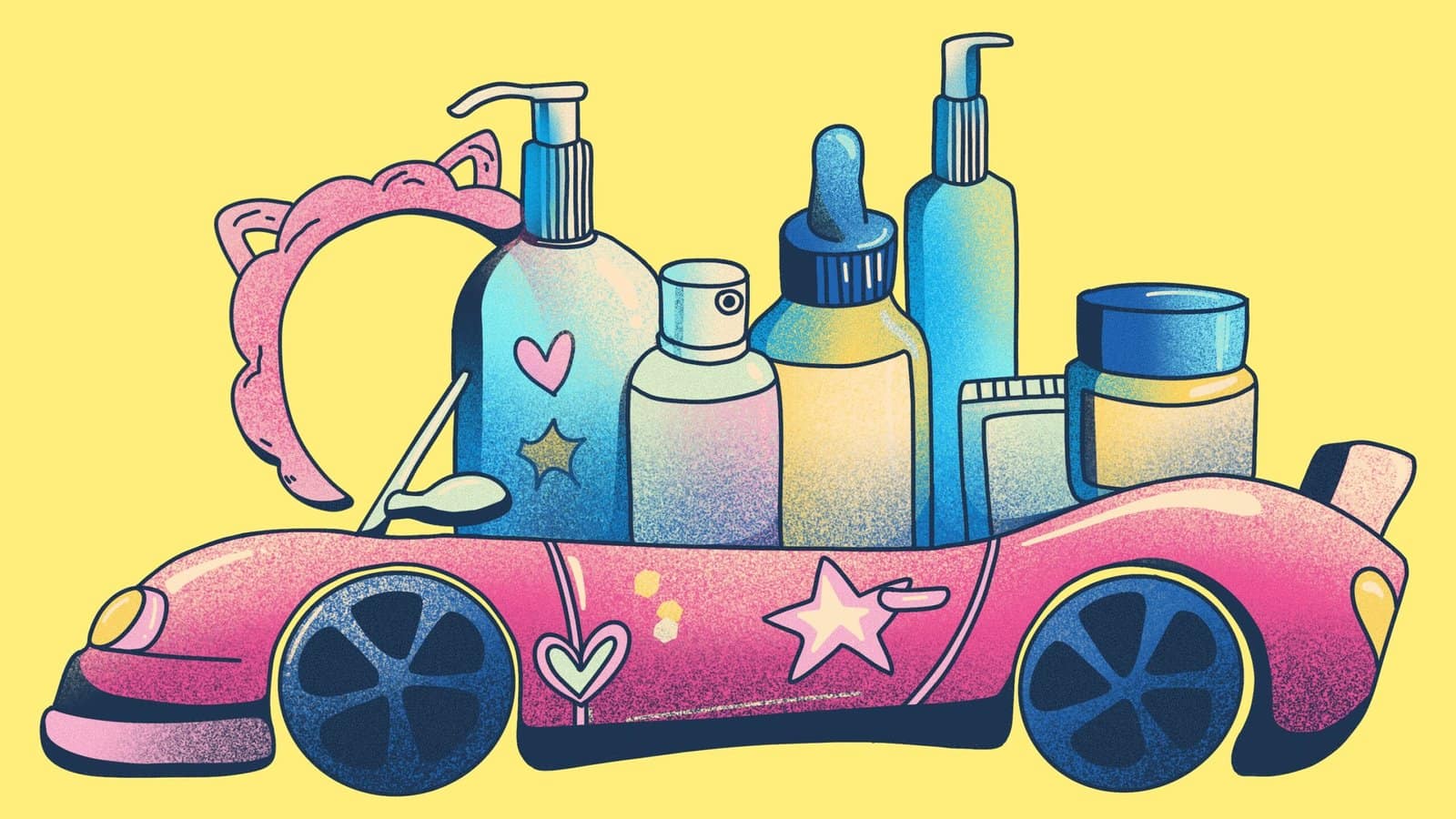
If Rini represents some kind of “late-stage capitalist hell,” as one commentator put it, it’s far from the only company in this particular circle of the inferno, in which 7-year-olds make “get ready with me” videos on TikTok. A handful of companies are now pitching regimens for children who are elementary-school age and even younger; some spas have begun to feature child-oriented menus. Tubby Todd Bath Co., which sells a basic lineup including bath wash, lotion, and diaper paste, asks customers if they’re shopping for “baby’s first skincare routine.” A TikTok from the company Evereden depicts a bathroom cabinet filling up with the brand’s products—a child-size skin-care headband, lip oil, fragrance, face mist—with the superimposed text “pov: your 3-year-old is interested in skincare.” (The company also launched a pink-packaged multivitamin face wash and moisturizer called the Barbie Kids Happy Face Duo, which comes with rhinestone stickers to bedazzle the bottles.) The tween-skin-care brand Pipa tells customers to “start young”—in this case, at 8, the average age that children in Generation Alpha who are using these kinds of products begin experimenting.
Dermatologically speaking, most kids don’t need a skin-care routine; soap, lotion, and sunscreen suffice. If the actual benefits of many skin-care products for adults are questionable, for kids, anything that goes beyond the basics is unnecessary. But Megan Moore, an elementary-school teacher in the wealthy suburb of Oakwood, Ohio, told me that by fifth or sixth grade, most of her female students have a mini-fridge at home specifically for skin care. Her 9-year-old daughter, Charlotte, later told me she’s hoping for her own skin-care fridge, too—once her mom lets her get products other than the ones she picks up as party favors. She walked me through a typical slumber-party routine, much of which I recognized from my own, early-aughts childhood: paint your nails, spritz perfume, braid one another’s hair, take your braid out in the morning to reveal “whatever funny-looking curl” it gave you. But some of the routine was new to me: get out your goodie bag, put on your skin-care headband, and don a sheet mask made for kids. (A brand called Yes Day, run by a 13-year-old CEO, offers a Sleepover Set for exactly this type of ritual.)
By the time they’re old enough to be Sephora Kids, at least some tweens are raiding skin-care aisles and buying adult brands such as Drunk Elephant—known for its bright packaging and premium price point. Those products can contain strong anti-aging ingredients, such as retinol, that can irritate a young person’s face. The parents I spoke with said they were willing to buy their kids skin care to help them adopt a good routine early or at least have a chance to try it out—as long as the products were safe. “Millennials created the wellness economy,” Kimberley Ho, a co-founder of Evereden, told me: Is it any wonder their kids are interested too? Companies like hers, she said, saw an opening for products formulated for children’s skin.
Perhaps unsurprisingly, adult-beauty retailers are welcoming these Gen Alpha–focused brands. Sephora began its expansion into the Gen Alpha skin-care category recently; Ho told me that Evereden will launch in Sephora stores nationwide next month. Sephora’s first Gen Alpha partner, Sincerely Yours, was co-founded by the then-15-year-old YouTuber Salish Matter to provide “skincare created with teens, for teens.” But when Matter held a rollout event at the American Dream mall, in New Jersey, she drew a roughly 80,000-person crowd that included many kids who were almost certainly middle-school age or younger. Presumably some of them persuaded their parents to buy Sincerely Yours’s four-step bundle: cleanser, sunscreen, moisturizer, and a serum mist. (Julia Straus, the company’s CEO and one of its co-founders, told me in an email that its customers’ average age is solidly in the teens, but that “we know younger audiences may show interest, especially at community events, and some of our products like sunscreen are a must for all ages.”)
The lines between hygiene, wellness, and beauty are blurry, and some of the companies sell products that fall under all three categories. The brands like to portray skin care as a normal part of childhood play. “For Gen Alpha, I feel like skin care is closer to slime-making or nail art or exploring different hairstyles” than an actual beauty routine, Ho told me. Rini’s next batch of products, released today, does feature more explicitly play-oriented “face and body crayons.” Charlotte told me that she and her friends like to use skin care because it’s fun, it feels good, and it “makes us feel more mature because we’re doing skin care and we’re 9-year-olds.” I’m sure that I would have begged my mother for Evereden’s five-piece set with the pink travel case, too.
But selling skin-care products that very young kids are meant to use daily is distinct from, say, letting a curious child re-create a parent’s nighttime routine with a dollop of yogurt. Mimicking adults is an important part of childhood play, but if actual skin care becomes the norm at a young age, it could deprive kids of the imagination that emulation normally affords, Katie Hurley, a child and adolescent psychotherapist, told me. A toddler using a prepackaged sheet mask is not doing as much learning or thinking as one who’s making their own version. Beauty products for kids also chip away at what psychologists call “middle childhood”—the years when kids are more independent but are not yet distracted by the self-consciousness of puberty, Susan Linn, a psychologist and the author of Consuming Kids, told me. Children want to feel older than they are, and skin care gives them that. But Linn and other researchers worry it gives them the insecurities of adolescence too.
Child-skin-care companies do, for the most part, market their products as tools for self-care, rather than correction. When I reached out to the companies mentioned in this article, Pipa, Evereden, Sincerely Yours, and Tubby Todd Bath Co. all said that they offered age-appropriate products, meant to promote skin health, and focused on cleansers, moisturizers, and sunscreens formulated for younger skin. “The goal isn’t to introduce adult beauty concepts early, but to normalize simplicity: sun protection, gentle cleansing, and barrier support,” Ho said. (Rini declined to comment.)
Charlotte seemed to think of skin care mostly as a game or as a way to express herself. But she was vaguely aware—as my friends and I were when we’d do “makeovers” using Lip Smackers gloss—that the products were part of a self-improvement project. “When you put on face masks, the ending result is a lot brighter than what you had before you put it on,” she told me. “I like my first look, but I like the second look a little better.”
If skin-care companies do make a meaningful push into the toddler market, they’re bound to hit adult opposition, Rebecca Watters, the wellness-insights director at the market-research firm Mintel, told me. Even parents who go for other child-self-care offerings—which these days include meditation apps for children, yoga for children, and superfood powders for children—might not buy into the idea that a 3-year-old needs aesthetically branded skin care. But the strongest skepticism I heard about toddler sheet masks came from Charlotte, with all the wisdom of her 9 years. “That’s really weird. I mean, who’s gonna put a face mask on a 3-year-old?” she told me. She couldn’t imagine her own toddler sister sitting still for the five to 15 minutes that the Rini mask recommends, or that such a young child would need a skin regimen in the first place: “If they get chocolate or mud on their face, you could just get a paper towel and wipe it off and they would be fine.” Rini has a new product for that, too—Bamboo Face Wipes that “soothe and hydrate with every swipe” at whatever mess a kid has made.