Editor’s Note: Read The Atlantic’s related story, “Zelensky Makes His Pitch to Trump.”
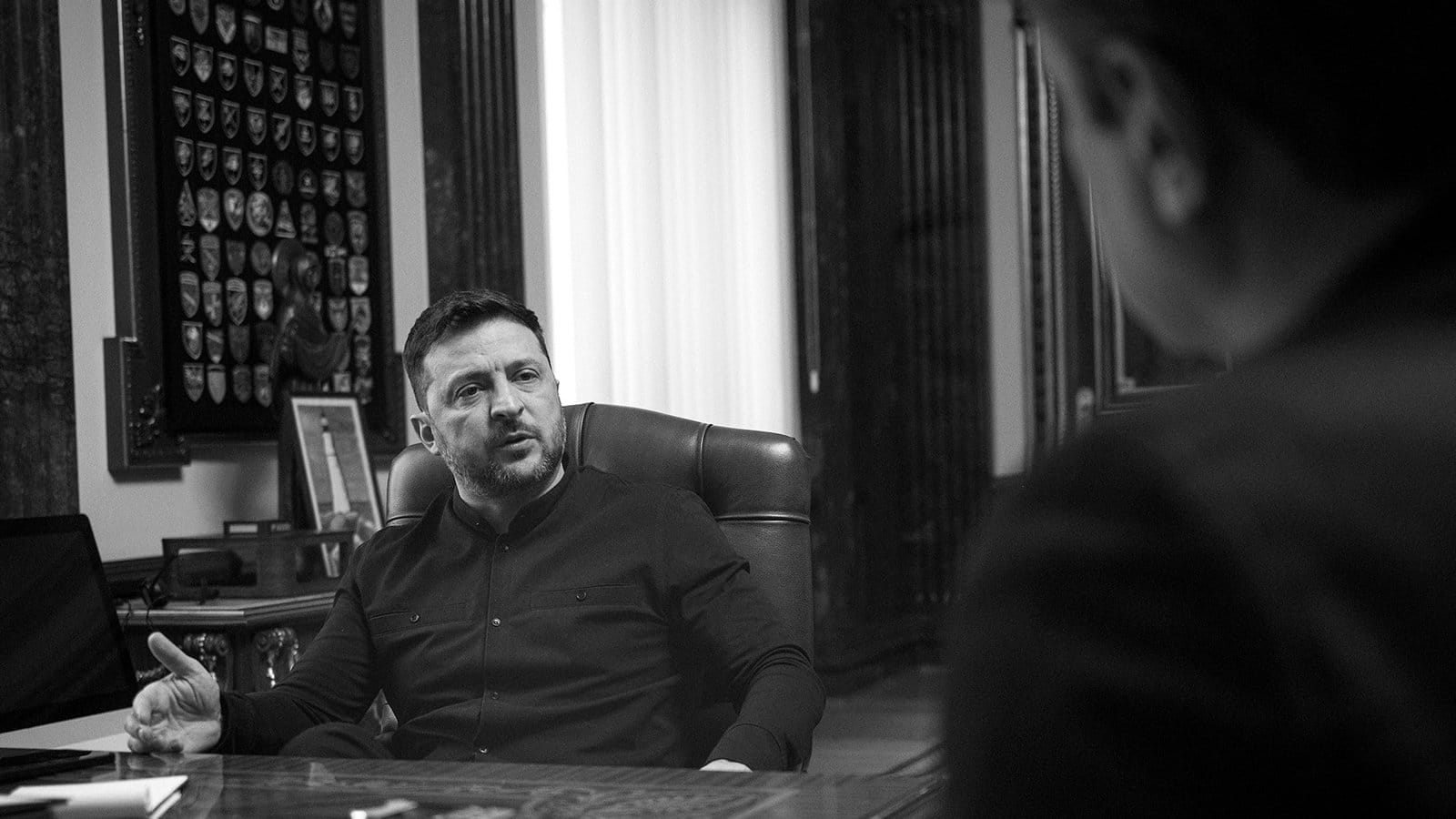
On Wednesday afternoon, Ukrainian President Volodymyr Zelensky invited me for an interview at his office in Kyiv. Nearly a year had passed since we’d last met in that room, which is adorned with the patches of military units fighting in the war against Russia. Back then, in March 2025, Zelensky wanted to talk about the argument he had had with Donald Trump in the Oval Office, a low point in their relationship.
This time, Trump was again on his mind. Zelensky sees the American president as the only one who can force the Kremlin to compromise and grant concessions for the sake of peace. And Zelensky seemed acutely aware of what might compel Trump to prioritize Ukraine’s interest in negotiating an end to the fighting after four years of war.
Later that day, Zelensky was due to meet his team of negotiators, who had recently returned from a round of talks with the Russians, in Abu Dhabi. Another round is scheduled for next week, and Zelensky does not want to miss this chance to reach a deal. But he insists that any such agreement must be acceptable to the Ukrainian people, whose approval he intends to seek in a referendum as early as this spring.
Zelensky told me a lot about these plans, what conditions must be met before they can move forward, and the crucial role he hopes Trump will play. What follows are excerpts from our conversation, which have been edited for clarity.
Simon Shuster: Thank you, Mr. President, for making time for this conversation. It’s a busy news day, and the news lately has not all been in Russia’s favor by any means. Their economy is struggling. Their casualties are enormous. How do you assess the balance of forces in the war today?
Volodymyr Zelensky: Ukraine is not losing. And I think the administration of President Trump has gotten that message. In some ways, it may have surprised them, because Russian propaganda is also working directly on them. Recently, we calculated that a single kilometer of occupied Ukrainian land costs them 170 casualties. That’s people killed or wounded so heavily that they are not coming back. We have all the evidence of this. To say that in these last six months they are winning somewhere? No.
Shuster: How does this state of affairs affect the negotiating process?
Zelensky: The tactic we chose is for the Americans not to think that we want to continue the war. It’s not enough just to say that we don’t want to keep fighting. That’s why we started supporting their proposals in any format. When they say, Let’s hurry and meet!, we say, Sure! Are you ready to freeze the line where you stand now? We’re ready. Are you ready for some compromises? Only if the other side wants to compromise. Are you ready to meet the Russians in America? For us, it doesn’t matter where, except Moscow.
Shuster: After the last round of talks, in Abu Dhabi, you said the Russian position softened in some ways. For example, they began discussing a trilateral meeting between yourself, Trump, and Vladimir Putin. What does that tell you? What’s the Russian tactic here?
Zelensky: In my view, they need to leave all our territory. That’s not possible as of today. But if we want to have a line of contact that does not run through the middle of cities, then someone will need to step back. If they say they will withdraw, and we withdraw, it could work in areas where, for example, you have the steppe. Where it’s a city, I think that makes no sense. If we leave, it will be a dead zone. That’s why I find that to be illogical. As for their suggestions about a “free economic zone” and all of that, for us it just means leaving our territory. I don’t see any justice in that. It’s not right.
Shuster: How do you understand the goals and interests of the American side in this peace process? What drives them?
Zelensky: I think there is no greater victory for Trump than to stop the war between Russia and Ukraine. This is the biggest ground war in decades. For his legacy, it’s No. 1.
Shuster: Have the Americans said how they would react if Russia were to violate a peace deal and attack Ukraine again? Are they prepared, for example, to impose a no-fly zone over Ukraine in response to another invasion?
Zelensky: We are talking about the fact that there will be a reaction. There will be weapons, sanctions, and pushback. The question is, what kind of pushback? There needs to be an understanding about these things. What does it mean to have the support of our partners, for them to push back? So far, we have, let’s say, positive signals, which need to become an understanding of real actions. We want to have a major understanding of what that reaction will be in the event of renewed aggression like we saw in 2022. What exactly will our partners do? We need all of this to be written out.
Shuster: About the no-fly zone—I remember you asked the Americans and NATO to impose one in 2022, to shoot down rockets flying over Ukraine without entering Ukrainian airspace. Do you have an understanding that the Americans would be ready to do that?
Zelensky: That hasn’t been fixed yet. We have raised it, and we will continue to raise all these questions, because there have been different proposals. For example, the coalition of the willing could have planes standing at the border of Ukraine, ready to shoot down aerial targets.
Shuster: You have expressed concern that the talks between the U.S. and Russia have touched on questions related to the sovereign territory of Ukraine. What did you mean exactly?
Zelensky: We know that the Americans are building bilateral relations with the Russians. We understand the signal that the Americans gave the Russians: Let’s start by ending the war. We support that position. It’s fair. Still, in our view, they cannot develop projects with them during this war. We have information that they are discussing bilateral documents amongst themselves. I have said that these documents should not include questions related to Ukraine. I’m not even talking about economics. For example, the Russians have appealed to the Americans in relation to this or that piece of occupied territory. And if they are building relations on our territory, we definitely have the right to know about it.
Shuster: Do you have information that such projects are being discussed in the context of the U.S. talks with the Russians?
Zelensky: No. I have information that the Russian side has raised. My view is that they are raising more dangerous information than what I told you. I’m talking about the economic side of things. Let’s imagine, for example, that Russia wants American recognition of some territory that is under Russia’s control. I’m not saying the Americans would do that. I’m just saying that they want this and are pushing for this to happen. I’m against these things. I think they are dangerous. And for President Trump, they are dangerous inside his country, in my view.
Shuster: How so?
Zelensky: Because America is a great democracy. They could be provoked into recognizing this or that territory, and that’s just impossible. If a great country will recognize temporarily occupied territory, then I think there could be many other territories that others could try to take by force.
Shuster: You have called on Putin to meet you to decide the most sensitive parts of the peace plan. How do you imagine such a meeting? What is it that you want to look him in the eyes and say?
Zelensky: It’s not about wanting to look him in the eyes. In general, I’m not interested in sentiments when meeting him. We have questions related to Ukrainian territory that no one can resolve today. The policies of different nations allowed Putin to opine on this topic by occupying land and making excuses for his actions. Right now there is only one power—Ukraine—that is physically fighting against him. And my conversation with him can only be focused on ending the war. That means our conversation must be absolutely open, insofar as that’s possible. It’s simply a conversation about how to end the war so that it does not start again.
Shuster: I can imagine it would be difficult for you to hold back your emotions during such a meeting.
Zelensky: Why should I be emotional or unemotional? What’s the difference? Our goal is to end the war. I think he might have a different goal. We don’t know. During the war, we have not met. Everyone has tried to do something about it, and yet the war continues. So in my view, it’s logical to have a meeting of leaders who can talk about the most difficult issues. Who else can I talk to about the questions of territory?
Shuster: Do you have the sense that he would be willing to meet with you? That he would sign a peace deal that includes, for instance, security guarantees for Ukraine?
Zelensky: I don’t think either side has a real desire to meet. We are enemies, after all. In all honesty, no one has expressed a desire to do this. But there is a willingness. I think it’s the right decision to meet and try to end the war. The Americans ask what we think about the idea of such a meeting. We said we would support it. We are ready to meet in any format, except in Moscow or Belarus.
Shuster: Some aspects of the 20-point plan for peace would be impossible to enact without holding a referendum. Will the Ukrainian people need to approve any part of the plan related to territory?
Zelensky: It’s not quite like that. In general, any agreements to end a war must be signed by the presidents, and then they must either be ratified by parliaments or through a referendum. I don’t believe we would manage to enact a plan that is really great for us and not good for the Russians. As I’ve honestly said, even if there is a plan to leave the front line where it is and to stand where we stand, it’s still better to hold a referendum, in my view. It’s not only better for us. Our people have gone through this war, and they deserve a right to vote yes or no. It’s a question of fairness. A referendum would have a lot of force in terms of guaranteeing security for Ukraine, because I’m sure that the whole world would recognize the referendum if it’s carried out in the right way.
Shuster: What is the timeline you expect or hope to have for organizing it?
Zelensky: It depends on the political will of the Russians. If they are really ready to end the war, and if the conditions around certain points that are now unacceptable to Ukraine will be changed through a reasonable compromise, then we can think about next steps. It can take several months. And if they are not ready, then what’s the point of even talking about it?
Shuster: Various officials in the U.S. have also raised the question of elections in Ukraine. When would you envision that happening?
Zelensky: You know, the United States raised the question of elections, and the Russians have raised this question. I said right away: No one is clinging to power. I am ready to hold elections, but for that we need security. Guarantees of security, a cease-fire. These things are necessary and absolutely clear. It has nothing to do with the date. We could have done it a long time ago.
When we hear these kinds of proposals, you know, sometimes I get the impression that it’s like: What else can we offer the Ukrainians just to see if they’ll refuse? We’re not afraid of anything. Are we ready for elections? We’re ready. Are we ready for a referendum? We’re ready. Let the people decide.
Shuster: Given the sequence of conditions you see as necessary for a deal, it does not seem like you are in a great hurry to make one.
Zelensky: No, that’s not right. We are in a hurry to end the war. We have losses. People, above all: soldiers, civilians. We need to be as close as possible with the partners who can stop Putin, and today that’s only Trump. Those who may be capable, I don’t see them doing much. And those who are trying are either incapable or the Russians don’t take them seriously. That’s why they decided that this is the easiest and fastest way to get rid of me. That’s why I think the idea of holding elections during the war has been, above all, the Russian position.
Later on, the American side picked it up. That’s no secret. I’m not blaming the American side for anything. But they raised the example of Abraham Lincoln, who held elections during a time of war in America. They said, Demonstrate that you are ready! And I said, I am ready.
Shuster: Do you have the sense that the next few months will be your window of opportunity to end the war, while President Trump is really engaged in this?
Zelensky: I think so. Let this be my subjective point of view, because I know that the American side sometimes gets offended when I express this particular opinion. But one thing is clear to me. The Russians can use this time to end the war while President Trump is really interested in that, when it’s very important and valuable to him. Valuable might sound too mercantile for some people. But let’s speak honestly. The most advantageous situation for Trump is to do this before the midterms. That would be a victory for him. Yes, he wants there to be less deaths. But if you and I are talking like adults, it’s just a victory for him, a political one.
Shuster: Let’s imagine the moment comes to hold a referendum that allows the people of Ukraine to approve a peace plan. What would be your message to them? How would you urge them to vote?
Zelensky: It depends what will be up for a referendum. If there will be proposals that have nothing to do with compromise, with a fair conclusion, if there will be unviable proposals, I certainly will not tell people to vote yes. In general, I have no desire to hold a referendum on proposals that will not work out. I think that’s not reasonable, and I argue with all the negotiators about this.
Shuster: What do you think of the idea of holding a referendum and an election at the same time?
Zelensky: Can that happen? It can. I’m all right with that. Above all, it needs to work, so that people turn out to vote. I don’t think we should put a bad deal up for a referendum. I consider that unfair on a visceral level. Imagine these people sitting there without light, without anything. Some of them would probably be willing to accept any conditions. But we cannot accept the conditions that Russia is offering, because they could turn around tomorrow and start another war.
Shuster: What happens if Trump says: That’s it—I’m sick of these talks, and instead he shifts his focus to domestic U.S. politics?
Zelensky: That would be bad. We do not want the Americans to leave these negotiations. I just don’t understand why the Americans would not see the value of all this for themselves. We are supporting their attempts to make peace. Yes, Trump could turn his focus to other interests. And if that stops the peace process, we would have a harder time pushing it forward.
Shuster: And then what? Everything would be decided on the battlefield?
Zelensky: Well, no, I don’t think so. I think there would still need to be some kind of negotiations in this or that format. The negotiations have already started. The issue is that I don’t yet see a desire on the part of the Russians to end the war. Yes, they are now showing more of a willingness, and that’s because of Trump. So let’s say Trump goes away. Then they would not demonstrate that willingness anymore. How will that affect their actions? It will not.
If they don’t want to end the war, then it makes no difference what we say. They will do everything not to end it. That’s why, regardless of whether America helps with the negotiations or doesn’t help, the result would be the same: The Russians will find ways not to end the war. It’s easier for us to end it with the Americans. It’s easier because they can force the Russians. I think Trump is the only person capable of doing that today.