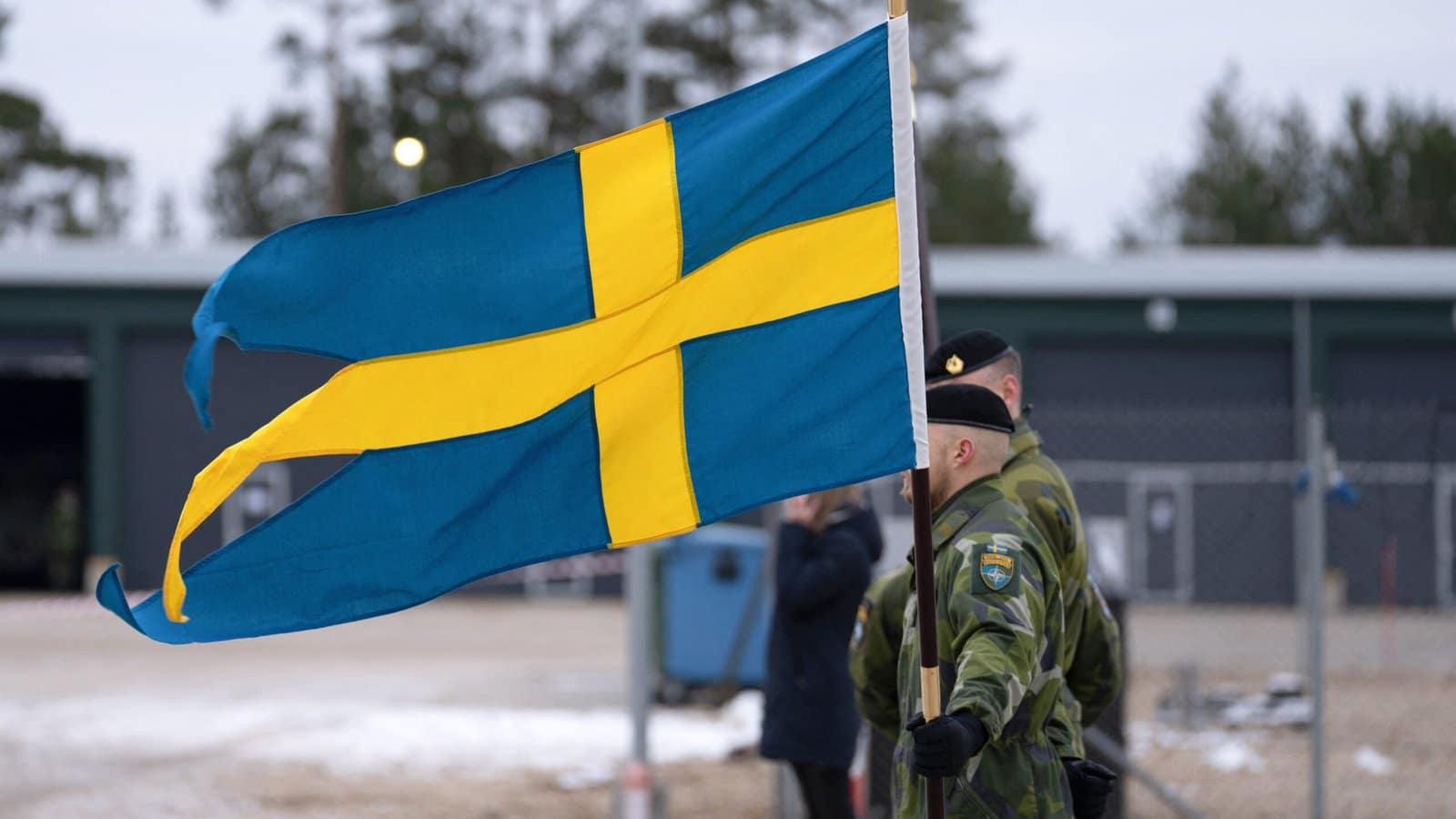
After World War II, peace-loving Sweden began working on a nuclear bomb to stave off a feared Soviet invasion. But in the 1960s, the Scandinavian nation scrapped the program under pressure from the United States, whose nuclear arsenal has shielded Europe for about 80 years.
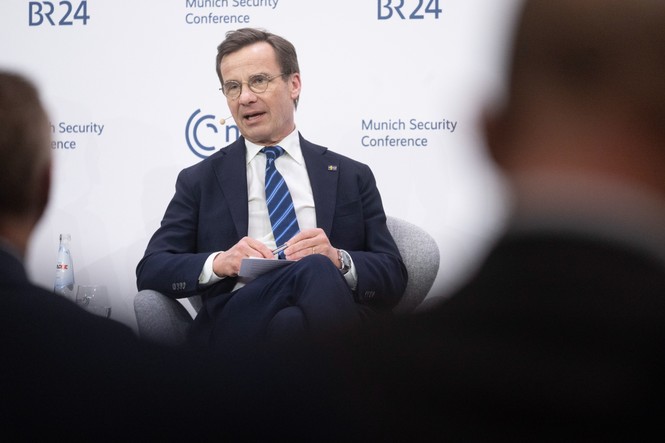
Sweden’s prime minister, Ulf Kristersson, reminded me of this history in an interview today. His country’s trust in a peaceful order maintained by Washington was once so absolute that it was willing to relinquish ambitions to attain the world’s most destructive technology. Now Sweden is having second thoughts, exploring more formal nuclear protection by Britain and France. “We are freshmen within all the nuclear planning of NATO,” the prime minister told me—but Swedes take that planning “very, very seriously.”
Kristersson is one of the hundreds of politicians, diplomats, security officials, and arms dealers gathering at the Munich Security Conference this weekend to consider the end of a period of unrivaled American power. In the new era, European leaders are not only promising to take more responsibility for the conventional defense of their continent; they’re also beginning to talk about an expanded nuclear deterrent of their own. Practically, this would mean leveraging the capabilities of Britain and France, currently the only two European states with nuclear weapons.
“That is being discussed more openly now than previously, and we take part in those discussions,” Kristersson said.
Several things about this statement—bland on its face—are head-spinning. Sweden hasn’t gone into battle since 1814, staying neutral through two world wars. It had one of Europe’s most prominent and politically potent anti-nuclear movements in the 1970s and ’80s. And it joined NATO only two years ago, prompted by Russia’s full-scale invasion of Ukraine. So it was noteworthy when Kristersson acknowledged having preliminary conversations with Europe’s nuclear-armed powers in an interview with Sweden’s public broadcaster last month. “We are now holding ongoing discussions with both France and the United Kingdom,” he said then, pointing out that Britain’s nuclear forces are integrated within NATO’s nuclear-planning mechanisms, whereas France’s are not. “They are not very precise yet, and the French are uniquely French, but France also shows openness to discussing with other countries.”
When we spoke today, the prime minister peppered his comments with caveats, necessary because of the risk of what he called “exaggerated interpretations” whenever the nuclear issue is raised. For now, Kristersson said, “the American nuclear umbrella is absolutely dominant.” And he has seen no indication that Washington intends to curtail it, even as the Trump administration presses European countries to assume greater responsibility for their own defense. Still, the prime minister said, “it’s a good thing” that there are European countries with such capabilities.
Having the capabilities is one thing. But now there’s renewed commitment to using them for the sake of common defense. Last summer, the leaders of Britain and France said for the first time that they would coordinate their nuclear planning, vowing to respond jointly if Europe came under extreme threat. In an address today at the conference, German Chancellor Friedrich Merz said that he was holding talks with French President Emmanuel Macron on the possibility of a collective European nuclear deterrent, declaring that U.S. leadership “is being challenged, maybe even already lost.” The rules-based international order, the German chancellor added, “no longer exists.”
One rule upon which that order was premised vanished very recently: The New START treaty, the last significant nuclear-arms-control agreement between the United States and Russia, expired this month. Even as the Trump administration tries to offload responsibility for the defense of Europe, its emissaries appear to not look kindly on the new European talk of nuclear weapons. Elbridge Colby, the undersecretary of defense for policy, told an audience in Munich today that Washington doesn’t support “friendly proliferation.” In remarks to NATO defense ministers yesterday, he affirmed, “We will continue to provide the U.S. extended nuclear deterrent.”
[Read: Countdown to an arms race]
But as Washington spews insults, bullies friends, and threatens to seize the sovereign territory of its allies, its commitment is becoming a devalued currency. Declining confidence in the United States has created its own pan-European lexicon. Vertrauensverlust, or “loss of trust,” is the word Germans are using. Kristersson taught me the Swedish analog: förtroendeskadligt, or “damaging to trust.” “We haven’t broken up, but we watch and listen carefully, and we are aware of the fact that we can be surprised suddenly, and we do not like that,” the prime minister said. “That’s the meaning of it.”
The security provided by the United States underwrote Sweden’s pacifism. “We became extremely against nuclear weapons,” the prime minister said. But with nuclear-armed Russia seeking to swallow a neighbor, he articulated a more realpolitik perspective: “As long as bad powers have nuclear weapons, democracies also need to be able to play.”
The outcome of Russia’s war in Ukraine will help determine how Europe approaches the nuclear issue, Kristersson predicted. The more favorable the result to Russia, the more compelling the case for heightened nuclear deterrence. The history, he noted, is instructive: Ukraine gave up the nuclear arms it inherited after the collapse of the Soviet Union in exchange for security guarantees from Russia, the United States, and others. Those guarantees turned out to be empty.
Kristersson was clear that his discussions are not about homegrown weapons of the kind his country sought after the Second World War. In 1957, the CIA assessed that Sweden had “a sufficiently developed reactor program to enable it to produce some nuclear weapons within the next five years.” The U.S. urged the abandonment of the program, offering reassurances about its nuclear umbrella. The government in Stockholm signed the Nuclear Non-Proliferation Treaty in 1968 and shut down its plutonium laboratory in 1972.
Today, the prime minister is emphasizing Sweden’s ability to benefit from nuclear capabilities belonging to what he called “friendly powers.” Still, when I asked whether he could rule out the kind of proliferation that Sweden nearly contributed to after World War II, before it changed course, he responded, “Can I exclude it for eternity? Of course I cannot.”