This is an edition of Time-Travel Thursdays, a journey through The Atlantic’s archives to contextualize the present. Sign up here.
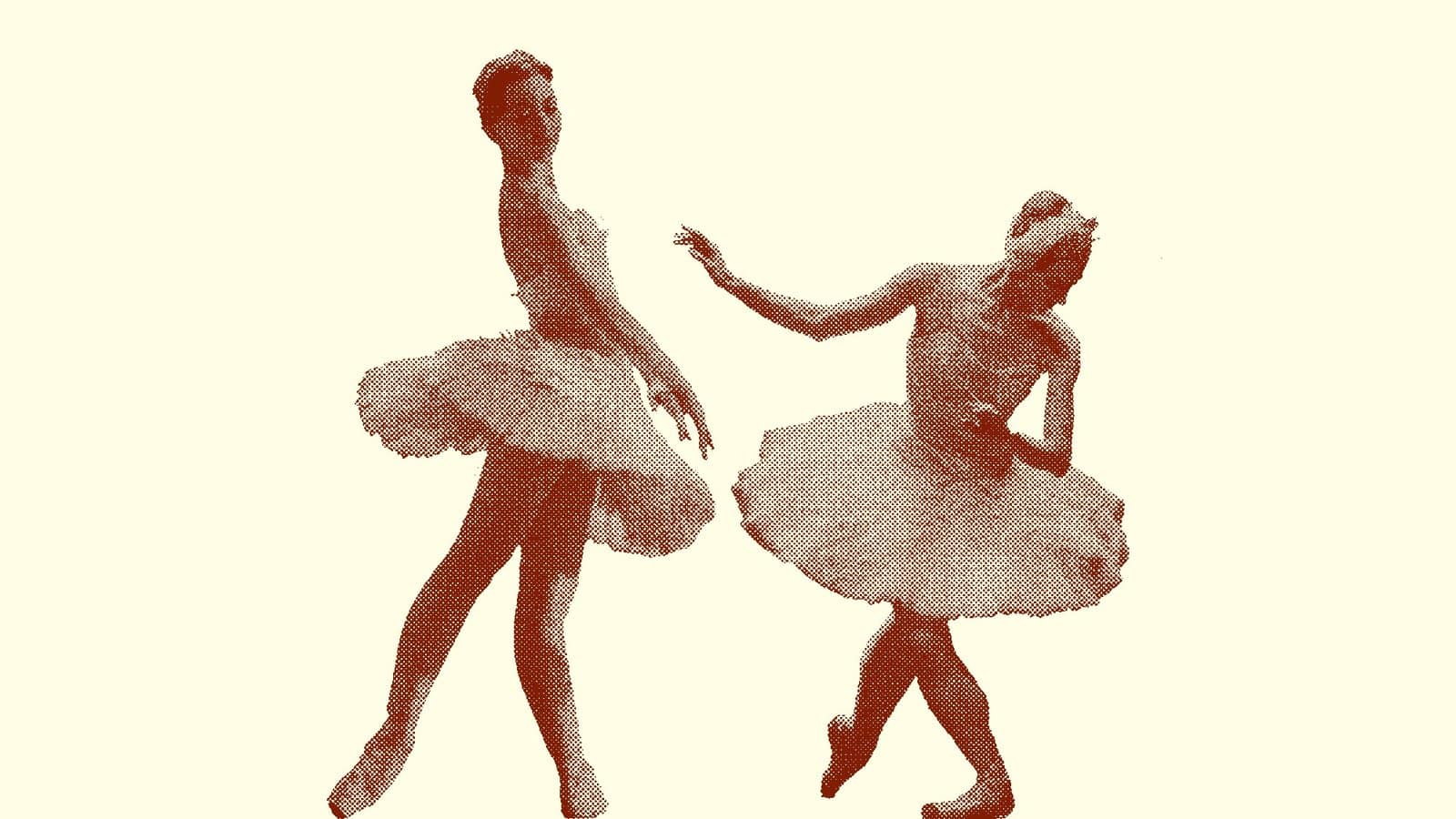
In July 2017, as the U.S. was racked by revelations that Russia had interfered in its presidential election, a group of envoys from both countries quietly brokered a peace accord in New York. They met at Lincoln Center. There, Moscow’s Bolshoi Ballet joined the New York City Ballet and the Paris Opera Ballet to perform Jewels, a landmark work by the American company’s Russian-born co-founder, George Balanchine. At the end of the performance, the dancers gathered onstage and took their bows—united, it seemed, by a shared commitment to virtuosity in ballet, and by their entangled roots.
This was the last time that the Bolshoi Ballet visited America. The company—which is largely sponsored by Vladimir Putin’s regime—may never again tour here, or in any Western country. Shortly after Russia’s invasion of Ukraine in 2022, theaters in London and Madrid canceled the Bolshoi’s scheduled performances. In 2024, dancers from another top Russian company were barred from a gala in New York City. Among the many costs exacted by Russia’s brutal war on Ukraine is the loss of a long-running cultural exchange; American and Russian ballet have always been in conversation with each other, even as they diverged aesthetically and faced political tensions behind the scenes.
In June 1960, an emissary from the Soviet ballet world argued in The Atlantic that dance could still flourish behind the Iron Curtain. The dance critic Yuri Slonimsky was writing for a special issue of this magazine featuring only Soviet authors. The aim, according to the then–editor in chief, Edward Weeks, was to offer a window into the “lively arts of a talented people” working under the yoke of the Communist Party. Slonimsky had been a close friend and artistic collaborator of Balanchine’s in 1920s Saint Petersburg, just after the Russian Revolution. Decades later, in New York City, Balanchine was being heralded as ballet’s great modernizer, having pioneered a form of dance that broke with Russian conventions—narrative-driven pieces; regimented, symmetrical movement—and better reflected the iconoclasm of a fast-changing modern world.
Slonimsky seemed to be addressing his old friend as he insisted that Soviet ballet also sought to meet the present, and that it was thriving in much the same way American ballet was, even with constraints. The Soviets were making ballet accessible, he wrote, by developing a large network of schools and theaters; they were nurturing versatile artists capable of asserting “human thoughts and feelings” and keeping their eyes “open wide to the surrounding world.”
Slonimsky would have heard about the recent box-office triumph of Balanchine’s Agon, a visionary work of radical abstraction that some likened to Picasso’s Guernica. Soviet ballets, by contrast, took up well-known stories from folklore or classic literature that party commissars had sanitized of any supposedly anti-Communist messaging. And yet, as Slonimsky pointed out, top Soviet dancers such as Rudolf Nureyev—who would seek asylum in France in 1961—strove to interpret “even the deepest past in a new way,” enhancing their limited repertoires with “modern techniques” (requiring more risk-taking and expressiveness) already familiar to American dancers.
At the same time, Balanchine and his peers understood that modern American dance was wholly indebted to Russian artists, whose innovations had established key principles and standards. In 1962, Agnes de Mille—best known for choreographing the musical Oklahoma!—offered Atlantic readers a guide to “creating a dance,” in which she encouraged fledgling choreographers to study the oeuvre of Marius Petipa, who had ushered in a golden age of Russian ballet in the 19th century. “Observe what Petipa does with just four steps in any of his solo variations,” de Mille wrote, referring to Petipa’s deceptively simple and rigorously plotted choreography, with its neat internal logic. Such precision in movement “is hard to learn,” but “it is, in fact, the essence of the business.” For de Mille, no less than for Balanchine, experimentation involved first mastering the fundamentals before moving past them to “taste the power of making something meaningful where nothing was before.”
Years later, a young American choreographer would heed de Mille’s advice, to spectacular effect. Twyla Tharp’s ballet Push Comes to Shove, which premiered in 1976, startled and delighted audiences with its coy, self-referential humor, and its flirtation with popular dance styles such as jazz and tango. But what held the work together was its basis in the “familiar courtly universe of classical ballet,” the critic Dale Harris wrote in a review for The Atlantic. With this foundation firmly in place, Tharp was free to improvise; Harris observed how her approach lent itself to “daring, idiosyncratic” dances with “an instant accessibility that makes the public accept as familiar what is, in fact, remarkably novel.” And at the heart of Push Comes to Shove was the phenom Mikhail Baryshnikov, who had defected from the Soviet Union in 1974, and whose technical prowess and singular flair made him a fitting symbol of this negotiation between tradition and modernity, old world and new.
Today, only a few prominent dancers in Russia have left in protest of the war in Ukraine; most have remained in the country, where creative opportunities have dwindled. Notable choreographers have refused to work with Kremlin-funded companies, and artists who question the war, or defy the precepts of Putinism, have been subject to censorship. A new iron curtain now separates American dance and Russian dance, bringing an abrupt end to a rich dialogue that spanned centuries. Swan Lake and The Nutcracker, two crown jewels in the American repertoire, would not exist without Petipa’s original stagings; meanwhile, Russian ballet was bolstered by American influence, becoming more technically adventurous and less self-contained.
Dance is no longer the robust industry it was in the time of Balanchine, de Mille, and Tharp, when government support for the arts was plentiful and theater-going more customary. But in its heyday, Russian and American dancers borrowed freely from one another to produce vital, distinctive art: the masterpieces we still revere today, and probably always will.