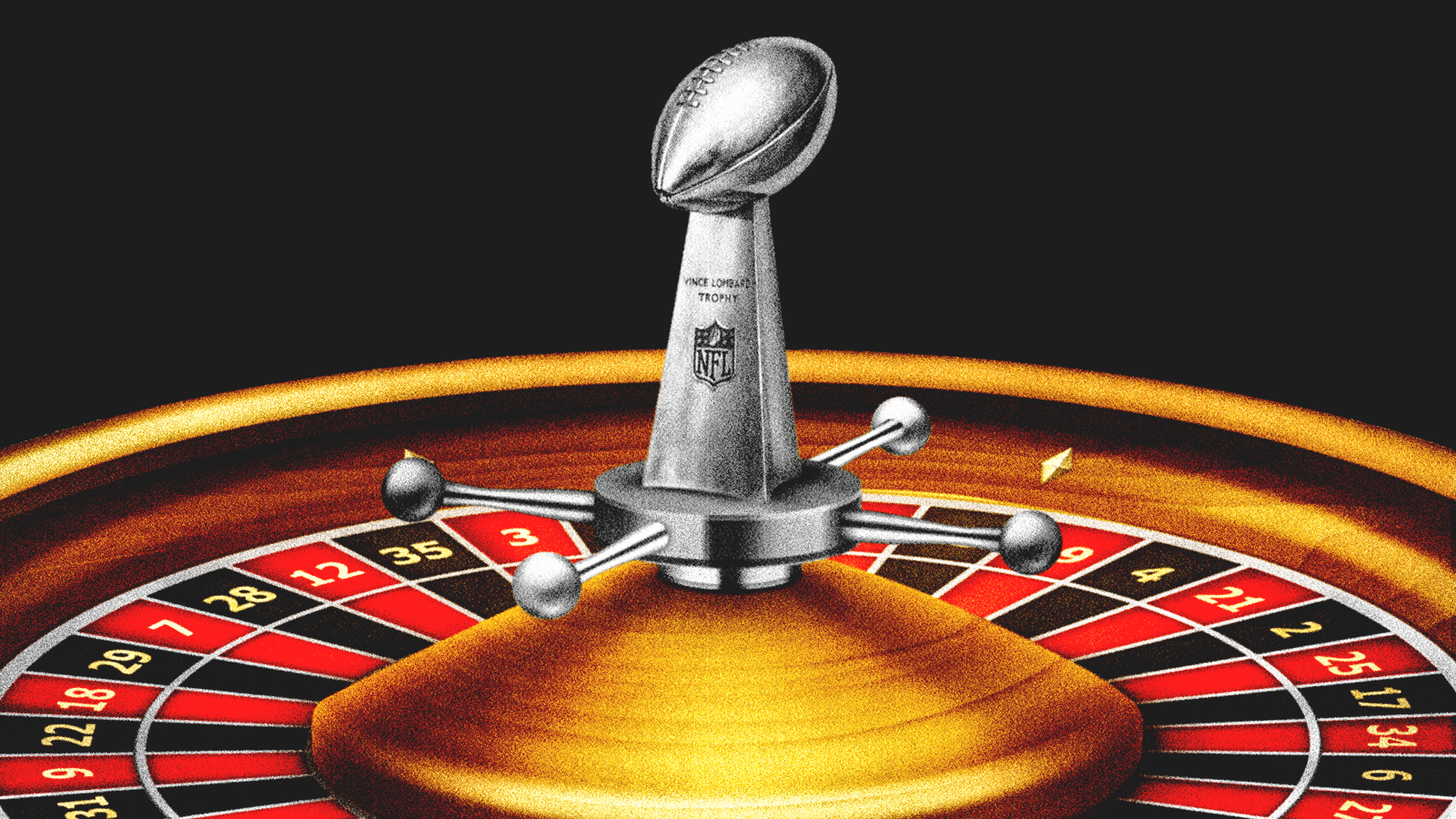
Nothing makes Americans want to gamble like the Super Bowl. Every year, the game is reliably the biggest day for sports betting: On platforms such as FanDuel and DraftKings, people are already putting money down on which team will win the opening coin toss, how long the national anthem will be, and what color of Gatorade will be used to douse the winning head coach.
Gambling on sports has become practically inescapable. Nearly half of American men ages 18 to 49 maintain an active online sports-betting account, and Vegas odds have invaded telecasts and talk shows. During NFL games, sportsbook commercials now outnumber beer ads. Despite all of that, more than a third of adults still cannot legally gamble from home: Online sports betting remains banned in 18 states, including California and Texas.
But for the past year, thanks to a loophole, Americans have effectively been able to bet on sports no matter where they live. All they have to do is turn to prediction markets. Platforms such as Kalshi let people wager on lots of things: Who will win the Oscar for Best Actor? How much snow will New York City get this month? Prediction markets say that they are more akin to the stock market than gambling. Rather than betting on odds set by bookmakers, users trade contracts that pay out according to the outcome of a given event. This distinction may not mean much for someone betting on the Seahawks over the Patriots, but it does allow prediction markets to operate even in places where sports betting is illegal.
[Read: The company making a mockery of state gambling laws]
Now America is about to find out what it really looks like when sports betting takes over. Kalshi, one of the country’s biggest prediction markets, launched its sport-betting operation just two weeks before the 2025 Super Bowl. This year, Kalshi has already seen more than $167 million in bets on the game, and that number could conceivably crack $1 billion, Dustin Gouker, a gambling-industry analyst, told me. Some of the biggest traditional sportsbooks and fantasy-sports sites, recognizing a work-around to enter states where gambling remains illegal, are seizing the opportunity: Since September, FanDuel, DraftKings, Fanatics, PrizePicks, and Underdog have all launched their own prediction-market offerings.
In one sense, prediction markets are about a whole lot more than sports. Both Kalshi and its biggest rival, Polymarket, have turned prediction markets into big business by letting people wager on seemingly everything. As Kalshi CEO Tarek Mansour put it in October, the company’s goal is to “financialize everything”—to let people bet on the outcome of virtually any event. By encouraging people to put their money where their mouth is, the thinking goes, prediction markets can forecast how the future will play out. Even if you’ve never placed a bet yourself, prediction markets’ odds about news and entertainment—not sports—are especially in your face. Both CNN and CNBC recently announced partnerships with Kalshi to incorporate the site’s predictions into their news coverage; last month, the Golden Globes displayed Polymarket’s odds throughout its broadcast.
[Read: America is slow-walking into a Polymarket disaster]
Kalshi may let you bet on topics as wide-ranging as whether Iran’s supreme leader will stay in power and who will win the next season of Survivor, but sports account for more than 90 percent of all trading volume on the site. From mid-December to mid-January, wagers on college basketball alone exceeded trading on everything other than sports. The single biggest non-sports market during this stretch—about whom President Trump would nominate as chair of the Federal Reserve—drew less activity than Italian soccer. In an email, Jack Such, a Kalshi spokesperson, told me that the categories that dominate the platform fluctuate based on what’s in the news. “During the NFL season, we are heavily tilted towards sports,” he wrote. “During the 2024 election season, we were heavily tilted towards politics. It all depends on what events are top of mind for the public.” Even though politics was big on Kalshi during the most recent presidential election, that was before the site offered sports betting.
Sports make up a smaller proportion of wagers on Polymarket, which has also yet to fully launch in the United States (although some Americans likely still access it by using virtual private networks). “At this moment in time, the use case of prediction markets, at least in the United States, appears to be the expansion of sports betting,” Gouker said. “It’s hard to come to another conclusion.”
This covert expansion of sports betting is controversial. Several states are suing Kalshi for operating an unlicensed sports-betting platform, which they argue deprives them of tax dollars. But late last month, Michael Selig, the newly appointed head of the Commodity Futures Trading Commission, the federal agency that regulates prediction markets, indicated that he intends to help grow the prediction-market industry. All of which suggests that, in the immediate term at least, prediction markets are likely to make sports betting an even more pervasive part of American life—potentially leading to devastating consequences. Research suggests that avid sports bettors are at risk of depleting their household savings, declaring bankruptcy, and even committing intimate-partner violence.
[Read: ‘I’m treating guys who would never be caught dead in a casino’]
Not all prediction markets, for their part, are likely to be content with staying de facto sports-betting sites. After all, Kalshi and Polymarket want to harness the wisdom of crowds to forecast all kinds of real-world events, not just sports outcomes. Despite Polymarket CEO Shayne Coplan’s recent proclamation that prediction markets are “the most accurate thing we have as mankind right now,” these platforms have much to prove on that front. When most bets are on sports, it’s especially hard to see what value prediction markets add. The kind of information gained by thousands of bettors laying down four-legged parlays on a Tuesday-night NBA game does not have the same utility as a more accurate hurricane forecast or election prediction. Not all knowledge, in other words, is created equal.
Perhaps prediction markets are hoping that once sports betting gets users in the door, they’ll engage with the many other markets on offer. “I think they’ve really thought that sports would just be an entry point, and then everything else would start growing,” Gouker said. But that Kalshi will be able to interest its droves of sports bettors in other markets is by no means guaranteed. In fact, it seems at least equally plausible that people might just prefer betting on the Super Bowl to betting on whether the Federal Reserve will lower interest rates. “People who are making forecasts on political and social and scientific outcomes are possibly different from people who are betting on sporting events,” John Phillips, the CEO of Aristotle, the company that runs the prediction market PredictIt, told me. “There are some commonalities there, but I think it’s a different type of activity and it attracts a different type of trader.”
If the goal of Kalshi and other prediction markets is to create something with genuine financial utility and predictive power, that’s a big problem. But this won’t prevent them from making a boatload of money along the way.